Tuesday, January 1, 2013

Freedom: Quaker and Backcountry


While Puritan and Cavalier notions of liberty are quite foreign to us, Quaker and back country concepts are familiar.  They live on today in the concepts of freedom espoused by the ACLU and the NRA, respectively.

 Quakers

Quakers introduced a radical new idea to the concept of law and order – that people need not all adhere to a common creed or fit into a common hierarchy.  Order simply meant people refraining from intruding on each other’s peace.  Quakers flogged and branded like anyone else in the 17th Century, but they generally opposed capital punishment, limiting it to cases of treason and murder.*  Sheriffs were semi-elective -- a vote was held among multiple candidates, and the governor choose between the top two vote-getters.  Quakers also had justices of the peace and peace keepers who arbitrated civil disputes.  The Quaker approach to law enforcement must have seemed dangerously permissive to their contemporaries, yet crime rates remained relatively low (though not so low as among the Puritans).  The reason for their low crime rates should be obvious.  They were Quakers (and Amish and Mennonites).  A society of pacifists can control crime by gentler means than other societies.  Local government took place mostly at the county level, by elective commissions and other officials.  Elections were frequent, as often as five times a year, but less demanding than a New England town meeting.  Perhaps as a result, voter turnout was usually lower than in Virginia, but higher than in New England. 

Fitting midway between their concept of local government and their concept of liberty was the matter of how politics were conducted.  Quaker notions of the conscience and the Inner Light meant a recognition of a right of dissent.  Long-standing differences of opinion between large portions of the community regarded as normal, rather than as a source of dangerous disruption.  Political parties began forming in Pennsylvania in the early 18th Century, about the same time they began forming in England, and well before they began to develop in any of the other colonies.   While local government in New England operated by consensus with strong pressure to conform, and in Virginia it was little more than a spoils system, in Pennsylvania , the whole concept of organized and civilized disagreement that makes democracy possible was being born.

Quaker concepts of freedom were rooted in the Golden Rule – respect in others the freedom you would have others respect in you.  Quakers did not see freedom as a zero sum game.  The saw it as the common right of all, and believed that the loss of freedom by one person(s) diminished the freedom of all.  More remarkably, the Quakers lived up to this ideal.  Power corrupts, and Fischer points out that all too often, people who are fierce in defense of their own freedom when out of power have second thoughts about other people’s freedom when in power.  The Quakers in power extended to everyone else the same freedom they claimed for themselves.  Quakers were also the earliest opponents of slavery.  If it was not their wish to be enslaved, then it could not be right to enslave others.  Fischer believes that there was no material reason slavery could not have flourished in the Delaware Valley; it was kept out because of the strong commitment of the Quakers and Pietists to reject it.  Fischer calls this ideal reciprocal liberty.

Reciprocal liberty had other implications as well.  Limited government was part of reciprocal liberty.  Implicit in it, Fischer says, was a clear distinction between the state and the larger society.  Such a distinction would have been quite foreign to the Puritans.  Also implied were that there were some things that were simply not government’s business (another concept quite foreign to the Puritans).  In particular, government had no business legislating in matters of conscience.  But at the same time, the existence government was essential to reciprocal liberty.  Its role was to keep people from infringing on each other.

Not all these ideas were unique to the Quakers.  They were part of the stirring of the new ideology of classical liberalism that arose in the late 17th Century among the Whigs and their struggle to curb the power of the king.  William Penn, besides Quaker ideals of reciprocal liberty, endorsed the secular liberties of the Whigs.  He guaranteed all colonists the secular rights to their lives, liberty and estate; representative government; and trial by jury.  The right to trial by jury included the right to a speedy trial, to the same right of witness and counsel as the prosecution, and for the jury not to be punished for its verdict.  No coincidentally, these are the same rights guaranteed in the Bill of Rights to the U.S. Constitution to this day.

Which leads to an important point.  The ideals that created the American Revolution were ones developed in the late 17th Century by John Locke and other English Whigs.  These ideas were not unique to the Quakers; indeed, it was Jefferson, descendant of the Cavaliers who set them forth in the Declaration of Independence and Madison, another such descendant, who enshrined them in the Bill of Rights. 

Back Country

Back Country ideals of liberty are also familiar to us.  They can be found in any pronouncement by the NRA or the gun lobby in general.  The back country was settled by people long excluded from political power, either in contemporary England, or in the colonies in their early days.  As a result back countrymen came to look upon any formal government as something hostile, alien, and inherently oppressive.  This went far beyond Quaker (or Cavalier) notions of limited government to an ideal (at least in theory) of no formal government.  Fischer calls this natural liberty, perhaps because back countrymen so often seemed to aspire to an anarchical “state of nature” that the other cultures dreaded.

Of course, the back country was never able to exclude formal government altogether.  But they generally sought to limit its influence.  Sheriffs, courts, and other official means of keeping order coexisted with vigilante violence and order maintained by private revenge.  Fischer cites the case of a judge who punished hog stealing with hanging, and the rape of a five-year-old girl with a one shilling fine.  What is does not add is that this did not necessarily mean the judge took child rape lightly.  He may just have wanted to allow the girl’s family the satisfaction of inflicting the punishment themselves.  "Order" in the back country meant retaliation in kind for any wrong done.  And if formal government was regarded with deep distrust, they were not without leadership.  Leaders were strong, charismatic individuals with a knack for getting things done, people like Andrew Jackson, who when a fire broke out in a stable, organized the townsmen to fight it, decked anyone who opposed him, and saved the town from burning down.  And he did it through is own forceful personality, not any trappings of formal office.  That was the sort of leader the backcountry respected.

Particularly strong in the back country concept of freedom was not only the ideal that all government was inherently dangerous to liberty, but that armed rebellion was the proper response the moment it stepped out of line.  Fischer gives the example of Patrick Henry, a back countryman to the core.  Patrick Henry was not just one of the most impassioned leaders of the American Revolution.  Before any stirrings of rebellion began, as a lawyer he argued to a back country jury that the king, by disallowing some obscure act, had degenerated into a tyrant and forfeited all rights to their obedience.  Cavalier gentlemen were shocked, but the back country jury responded favorably.  He famously shocked low country gentlemen as well at the time of the Stamp Act, appearing to call for rebellion well before most people were even considering such a thing. At the same time, he did not hesitate to call anyone who opposed the Virginia Resolves and enemy of the colony.  Natural liberty, Fischer comments, was not reciprocal.  Respect for the rights of others was not a part of liberty in the back country.

I must confess to finding this the most puzzling part of "natural liberty," either as Fischer sets forth in his book, or in the NRA and gun lobby today.  I can more or less understand that people who see freedom as a thing for every man to vindicate with his gun not being concerned with the rights of others.  Presumably my neighbor has a gun of his own and is just as capable of vindicating his liberty as I am.  This is the NRA view of freedom as an armed standoff, with no one daring to infringe on the rights of others for fear of armed retaliation.  What I cannot understand is people who regard the proper response to the slightest provocation by the state as armed resistance simultaneously being willing to use the state to suppress people who disagree with them.  This tendency has continued from Patrick Henry's calling opponents enemies of the colony to present day NRA calls to deport Piers Morgan for disagreeing with them over guns.  Such an outlook, taken to its logical conclusion, would lead to endless civil war, as the "ins" use the power of the state to suppress the "outs" while the "outs" vindicate their rights with firearms.

In another work, Fischer comments that "Don't Tread on Me," with its emphasis on the first person singular, is very much a back country concept of freedom.  Extending it a little further, the Puritan equivalent might be "Don't Treat on Us," the Quakers might say, "Don't Treat on Others," and the Cavaliers, "I Do the Treading."

Fischer proceeds to take his thesis too far, reducing almost everything that happens in US history to the interplay of the four cultures, which is certainly a great oversimplification.  But it is a useful analysis nonetheless; one that I intend to make future use of.

_______________________________________________
*One thing I learned in law school was that today’s concept of first degree and second degree murder was invented by the Quakers as a way of reducing the number of executions.

Freedom: Puritan and Cavalier


The subjects of how these four societies maintained law and order, their forms of local government, and their concepts of liberty, are closely interconnected.  They may also be significant in forming our concepts of liberty to this day.  It should be noted, all four cultures valued freedom highly.  Indeed, all may be said in some degree to have  migrated in search of freedom that they felt denied at home.  But they had very different concepts of freedom – some familiar to us, and some quite foreign.  Because this is a complex subject, I will split this post in two.

New England

Puritan New England had very low crime rates.  Furthermore, crimes of violence were especially rare, with property crimes more common and trivial offenses against “order” the most common of all.  How was this achieved?  Most today people would say, because of the Puritans’ severity with law breakers.  The harshness of their punishments – the pillory, the stocks, flogging and branding and so forth – are famous to this day.  But such severity is unlikely to be the explanation.  Barbaric as such punishments may seem to us, they were universal in 17th Century Europe.  Virginia, contemporary England, and continental Europe all did much the same.  Even the gentle Quakers flogged and branded.  Indeed, in at least one respect, the Puritans were less severe than most of their contemporaries – they had fewer capital crimes.*  In another way, they were very strict.  Colonial New England might be considered an early example of the zero tolerance approach.  Just about everyone was prosecuted at some time for some minor offense such as breaking the Sabbath, idleness, lying, swearing, and the all-encompassing “exceeding the bounds of moderation.”  One colonist was prosecuted for presenting a petition on an insufficient size and grade of paper!  The penalties for these offenses were usually not too harsh – rarely more than a few shillings' fine – but warning was ever present.

So if severity of punishment does not explain the Puritans’ success in keeping crime down, what does?  For one thing, as discussed earlier, they lived in small, close-knit villages where everyone could keep an eye on everyone else and bring pressure to bear on deviants.  For another, the Puritans were selective in who they admitted, screening out people who did not share their basic outlook and values.  Their form of local government also played a role -- the famous New England town meeting.   Although Fischer emphasized that the concept originated in England, town meetings in England meant vastly different things in different towns.  In New England, town meetings were standardized.  The townsmen met, elected their officials, and enacted town ordinances.  (They also elected their representatives to the colonial legislature and instructed them on how to vote).  Every effort was made to achieve consensus.  Hence decisions were made by discussion, persuasion and adjustment of differences, together with strong pressure to conform.  The result was to greatly strengthen the moral authority of the law.  Who can object, after all, to being bound by rules enacted by one’s fellow townsmen, including oneself?  Law enforcement was the job of the village constable, also elected by the consensus of his fellow townsmen, which, again, greatly enhanced his moral authority.  The whole concept of a hostile or defiant attitude toward authority was foreign to New England because the people were the authority.  What they were hostile toward was any outside meddling.

Such a regime was possible only for a people whose concept of liberty was very different from our own.  Fischer describes it as “ordered liberty.”  It was the view that liberty was not the absence of constraints on the individual, but membership in a self-governing community that decided for itself what restraints to impose.   The New England authorities established many restraints on the individual.  They forbade people in frontier communities from moving without permission of the authorities.  They mandated Sabbath observance and church attendance.  One community forbade any bachelor from marrying until he killed six blackbirds and a crow.  Another forbade any farmer from slopping his pigs until two others confirmed what he was giving was unfit for human consumption.  Liberty, in short, belonged to the community, not the individual.  Individuals merely had “liberties,” something between our concept of rights and privileges.   These were not inalienable rights, but privileges the community granted and could withdraw at will.  In short, the Puritan concept of liberty has fallen by the wayside and is quite alien to our own.

Virginia

Rates of violence were higher in Virginia than in New England, but violence, like so much else, was rigidly hierarchical.  Violence by social superiors against inferiors was common.  Violence among social equals was intermediate.  But violence by social inferiors against social superiors was rare and subject to terrible retaliation.  The head of law enforcement in Virginia was the sheriff.  In New England, law enforcement was in the hands of the village constable, while the office of sheriff was abolished as what Fischer calls a “hated symbol of royal prerogative and aristocratic privilege.”  Alas, he does not explain what a sheriff was, or what made him such a symbol, other than that the sheriff was necessarily a country gentlemen.  The same shortcoming applies to his description of many other offices as well.  The vestry was the administration of the parish, which managed church matters, as well as “much other secular business," such as administering the poor law.  Alas, once again, Fischer does not describe what else the vestry did, except to say it was less active in the life of the community than the town meeting and presumably subjected individuals to fewer constraints.   The other main form of local government was the court, and especially the county justice of the peace.  Unlike in New England, where these officials were elected by the town meeting, in Virginia they were appointed by the colonial legislature (the famous House of Burgesses).  In theory, the legislature could appoint whoever it pleased to office.  In practice, the local country gentry would decide who should hold which office and the legislature almost always respected their wishes.  The only elective offices were to the colonial legislature.  Elections took place about once every seven years.  But Fischer finds another interesting comparison between the colonies.  In New England, where the town meeting met once a year to elect officials and as many times between as necessary to manage the town business, turnout was low, except in times of crisis.  In Virginia, where elections were rare and special events, turnout was much higher.  Apparently people are more willing to participate when participation is not too demanding.

The Cavaliers cherished their freedom, but had little respect for the freedom of others (especially their servants and slaves).  Fisher calls their attitude one of “hegemonic liberty,” equating freedom with domination of others.  Although he does not put it that way, Cavaliers assumed that it was the inevitable nature of society for people at the top to oppress people at the bottom.  Liberty was being as high up in the social order as possible.  This is related to, but different from, the Puritan view of “liberties” granted as special exemptions from restraint.  Puritans, too, believed that a gentleman had more liberties than a person of lower order, much less a servant or slave.  But at the same time, Puritans also recognized other “liberties” as common to all, and some (fishing rights, for instance) that were granted by community, rather than by rank.  To Virginians, liberty was mostly a matter of who dominates whom.  This makes liberty a zero sum game – one person’s gain in liberty is necessarily someone else’s loss.  Suddenly I began to understand why southerners felt so threatened when anyone sought to undermine slavery.  If one’s view is enslave or be enslaved, then any threat to one’s ability to enslave is necessarily a threat of enslavement.  It explains the maddening view so often expressed by apologists for slavery – that it elevates all white people to an aristocracy.  If one views freedom in hegemonic terms then, yes, I suppose race slavery could be the most effective way to extend hegemonic liberty to the greatest number of people.   It also goes a long way to explaining why marriages were so often power struggles – marriage, too, could not be a partnership, but only a question of who dominates.

It is also true that the Cavaliers moved beyond this view.  After all, Jefferson, who wrote so eloquently about universal natural rights in the Declaration of Independence came from this culture.  It is an outlook that goes clearly against the one the United States adopted as its ideology in 1776 and since.  But traces remained, especially in race relations, which were conceived of as a zero sum game long after the zero sum view had been abandoned everywhere else.  It is an outlook that remains tempting to this day because it is a more natural outlook than the one that no one need dominate anyone, but that we should all be free together.

___________________________
*Of course, just because the death penalty is on the books for an offense does not necessarily mean that it is enforced.  But Fischer also compares the actual numbers of executions in Massachusetts to Virginia.  Virginia had a much higher rate.

Thursday, February 23, 2012

Albion's Seed: Wealth and Rank

Wealth and rank are obviously related, although not the same. One thing Fischer discusses is that in the 17th Century, rank was seen more in terms of "orders" and "degrees" than wealth. The more materialist concept, equating wealth and rank, began in the 18th Century. Perhaps a more important concept he does not discuss directly is what a society means by equality. He describes at length (later) what the four different cultures meant by liberty. But implied in the text is that there are at least two different concept of equality -- equality of wealth and equality of manners. These things often correlate, but not always.

They correlated fairly well in three of the four societies, but with one striking anomaly.

In Virginia, distribution of wealth was very unequal. A narrow oligarchy owned most of the land and nearly all of the slaves. While there was a middle class of land holding yeoman farmers, they were not numerous. Far more common were landless tenants and migrant laborers. Indeed, in a land with abundant natural resources and a distinct shortage of labor, Virginia nonetheless managed to have a significant number of paupers. And, of course, there were slaves who by definition never owned anything, even themselves. Not surprisingly, rituals of deference were eleborate. Fisher remarks that rituals of deference were more elaborate in the 16th and 17th centuries than at any time before or since.

The Quakers, by contrast, were fierce egalitarians, both in wealth and in manners. They set out to make a deliberate policy of encouraging owner-cultivated family farms of roughly the same size, and of discouraging great landholders, landless tenants, and slaves. About three-fourths of all Virginians came over as indentured servants. While they might serve out their term of indenturement, their chances of advancement were slim to none. Quakers, by contrast, had about half the members of their colony come over as servants, but once their term was complete, they could take their places in general society. Quakers were also shockingly egalitarian in manners. They rejected bowing, curtsying, raising of hats, and all the other elaborate rituals the time, and instead greeted everyone with a handshake. They also dropped the elaborate titles of the day, such as "my lord," "your grace," "your excellency," "master," "mistress," "sir" or "ma'am." Everyone was simply addressed as "Friend." Quaker's famous use of "thou" and "thee" was also originally part of their radical egalitarianism -- they addressed social superiors in the familiar.

The Puritans were somewhere in between. Their goal was to keep something like the society of an East Anglia village, maintaining the social distinctions that would exist within such a society, but excluding both the top and bottom of society that would not be part of their village. This manifested itself in both wealth and manners. Like the Quakers, Puritans set out to create mostly a middle class of family farmers, and to avoid great landlords or landless tenants. The did not, however, divide land equally, but reserved a larger share for more prominent members of society. (The ratio was about 3:1). The Puritans deliberately excluded an aristocracy from their society, so there were no "lords" or "graces," but the leading members of the community were addressed as "your excellency" or "your honor." Gentlefolk were "master" and "mistress." The yeomanry were "goodman" and "goodwife." Only the poor and landless had no titles.

The anomaly was in the back country. Contrary to popular belief, frontier conditions did not make for equality of wealth. Despite abundant land, it was concentrated in relatively few hands, with large numbers of landless tenants. Fischer says the back country had the least equal of all four cultures, but his statistics do not bear this out. Rather, the least equal counties look comparable to the most equal counties in Virginia; while the most equal counties in the back country have wealth distributions similar to Boston, the least equal part of New England. The reason people do not think of Appalachia or the back country in general in those terms is that manners there were very equal, scandalously so to outsiders. People of all ranks addressed one another by their first names. Rank made very little difference in terms of manners, dress or rules of conduct.

Fischer suggests that people's concepts of deference, like their attitudes toward witchcraft changed with the times. The later migrations, the Quakers and back countrymen, were less rank-obsessed, as rank and rules of deference were beginning to decline. Color me unconvinced. The egalitarian manners of the Quakers and back countrymen scandalized their contemporaries and were seen as radical departures from accepted norms.

The truly striking thing is not just that there are (at least) two different concepts of equality, but that the back country attitude appears to have won out. Americans today are willing to tolerate substantial inequality in wealth. What we are not willing to tolerate is any sort of inequality in manners or any demand to show deference to our "betters."

Next up (perhaps over several posts) order, local government, and concepts of freedom.

Monday, February 20, 2012

Albion's Seed: Learning, Time and Work

Learning

Reading about the cultures' attitudes on learning, I could begin to see where a lot of Americans' later attitudes toward learning come from. Puritans had great regard for learning. It was from them that the whole idea that every child should go to school comes from. Every community was required to provide schools, and every child to learn to read (though not necessarily to attend school). To Puritans, it was everyone's duty to learn to read in order to read the Bible. They were the first society to achieve universal literacy. They also supported higher education, quickly establishing colleges to train ministers.

Cavaliers, by contrast, seem to be responsible for our common view of learning as elitist. For Cavaliers, learning was elitist. It was a thing every gentleman should have to show his status as a gentleman, but not to be allowed to the common people, lest it give them dangerous ideas. Is it any wonder, then, that the lower classes distrusted learning and literacy as tools of oppression.

Quakers originally came from the lower classes whose superiors didn't want them to be educated. This colored their attitudes, in interesting ways. On the one hand, they wanted to make basic education available to all, with an emphasis on learning the practical. But they distrusted higher education as elitist and "needless." Certainly these are attitudes that live on with us today. Having no clergy, Quakers particularly distrusted learned ministers.

As for back countrymen, their basic attitude toward learning was than when you are fighting endless war with hostile Indians (or between the English and Scotts in borderlands), struggling to get by on a small plot of land, and frequently on the move, you have other priorities. Some schools were available, and learned ministers were much admired. Back country schools also practiced an odd ritual called "barring out the school master." Just as weddings once involved real abductions and violence but later came to practice them only as rituals, so it was with education. Around Christmas time, students would lock their school master out in the cold and let him in only when he promised a long vacation. This practice went back as late as 1558 and appears to have begun as real conflict, but later taken the form of a playful ritual.

Although Fischer does not emphasize this, the century between the Puritan and back country migrations also reflect changes going on in English societies. Fischer remarks how high literacy rates were among the Puritans, significantly higher than in England as a whole. He also comments on the low literacy rates of back country migrants, among the lowest in England. Yet the actual literacy rates he gives for the two migrations are about the same!* The general education level had risen enough that what was once a high rate of literacy had become a low one.

Time and work:

Time and work are closely related subject because work is often governed by time, whether the factory clock, or farm seasons.
Puritans were famously uptight about time, believing it must be put to good use and never wasted. (Benjamin Franklin famously illustrated this attitude in Poor Richard's Almanac). But, Fischer warns us, this must be seen in context. Puritans lived by clock time to an extraordinary degree for the 17th Century, but their clocks were sun dials or mechanical clocks without minute hands. Concern for minutes as well as hours is a product of the Industrial Revolution. Time is a cyclical as well as a linear concept. In terms of cyclical time, Puritans were the strictest of all Christians about the Sabbath, following the Orthodox Jewish concepts of beginning the Sabbath at sundown on the previous day, and forbidding any work, even cooking, or any recreation. But they forbade Christmas, Easter and all religious holidays except the Sabbath. Puritan religious fervor has some paradoxically secularizing effects. Marriages were performed by magistrate, not ministers, and religious holidays gave way to the civic holidays of Election Day, Commencement Day, Training Day (for the militia) and Thanksgiving.

As for work, Puritans were mostly farmers, but soon grew a small surplus for sale and began cultivating a class of merchants. Though a commercial people, they were far from today's laissez faire concept of anything goes. They had strict concepts of what was a just price and forbade a merchant from even raising prices to make up for goods lost a sea. (The assumption was that if it was a merchant's karma to lose wares, it must be punishment for some sin. Only in time of a general shortage could prices be raised, because that showed God was smiting the commodity and not the man).

Cavaliers, predictably, saw time as hierachical. A gentleman's time was his to "kill" in recreation; the lower orders had their time occupied with work. In terms of cyclical time, the High Church Anglicans of Virginia were surprisingly semi-Catholic. They celebrated not only Christmas and Easter, but Lent, Shrove Tuesday, Ash Wednesday, Lady Day (the day Archangel Gabriel appeared to Mary, known to Catholics as the Anunciation), and many saint's days. Time was also largely governed by the cycle of growing tobacco -- sprouting, planting, weeding, pruning, harvesting, and curing. Needless to say, all this was a lot of work and occupied a great deal of a gentleman's time (even if he only oversaw the process and did not do actual manual labor). Yet in this culture work was considered unbecoming a gentleman, and living within one's means was considered "mean spirited."

Quakers saw things in quite different terms. They regarded leisure as idleness and debt as immoral. Their ethic was that of a businessman -- live within one's means, keep good records, invest any surplus in something useful instead of blowing it in conspicuous consumption, oh yes, and help out fellow Friends in need. Is it any wonder that, although the original Quakers were poor, their descendents did not stay that way. Quakers were to play a major role in banking, insurance, and industrial development. Like Puritans, Quakers focused on putting all time to good use and rejected religious holidays. They also rejected the traditional names of days of the week and names of months on the grounds that they were taken from the names of pagan gods. Instead, the simply used numbers (First day for Sunday, First Month for January, and so forth).

Back countrymen, for the most part, lived and worked at the mercy of the seasons. They celebrated Christmas on January 6 with bonfires, fireworks, and celebratory gunfire, and Easter with great revelry.

Next up: Wealth and rank (not the same).

Saturday, December 3, 2011

Albion's Seed: Food, Clothing, and Recreation

Puritan food was invented by Englishmen who didn’t approve of enjoying anything too much. Interestingly, what most people these days would think of as the archetypal New England food, clam chowder, appears to have been a later invention. Puritan staples were baked beans and rye ‘n’injun bread (corn and rye bread; wheat proved vulnerable to disease and was used only on special occasions). As everyone knows, Puritans also dressed austerely, extending to not bathing often. They wore “sadd” (serious) colors, though black was reserved for elders and authority figures, and passed sumptuary laws forbidding extravagance in dress to everyone.

The Puritan attitude toward recreation was that people should get enough recreation to maintain their physical and mental health, but not overdo it and engage in recreation just for fun. They recognized both that exercise is good for you and that people who never have any fun fall into dullness and discontent. Their favorite form of recreation was organized team sports. (This, perhaps, reflects their tight-knit nature. Having fun should be an organized community activity). Many of the team sports we play today originated in New England and were carried to other parts of the country by Yankee expatriates.

Virginians were notably hierarchical in their food, clothing and recreation. Food and clothing should not be surprising. Eating fancy food and wearing fine clothes are traditional privileges of wealth and rank. And, indeed, the gentry ate elaborate meals, with a focus on the “fricassee” or spiced, stewed meat. Plain folks ate more plainly. Feasting and entertainment were much practiced. Clothing was also hierarchical although, Fischer stresses, the gentry never dressed so extravagantly nor poor folks so miserably as in England. Sumptuary laws in Virginia were addressed less to curbing excess, but to keeping people from dressing above their station.

What may be surprising was that there was also a good deal of hierarchy in recreation. Horse racing was very popular, but only gentlemen were allowed to place bets . Male Virginians of all ranks engaged in blood sports, but there was a strict hierarchy in who was allowed to kill what. Gentlemen hunted deer and foxes. Common folk engaged in gander pulls, cock fighting and cockshairling (tying a rooster to a stake and killing it by throwing objects at it). Boys played “muzzle the sparrow," that is, they tied their hand behind their back, held a sparrow by the wing with their teeth, and tried to bite its head off. Puritans and Quakers regarded these sports as barbaric.

Quakers were an ascetic bunch, even more so than Puritans. Their food nonetheless sounds more appealing. It tended toward puddings and dumplings, and “cheeses.” “Cheese” did not mean cheese, but food slowly boiled down to preserve it. They ate cream cheese (Philadelphia!) and “fruit cheese,” meaning fruit boiled down and preserved with sugar and spices. Meat was also preserved by salt, sugar and smoking. They appeared to make heavy use of sugar as a preservative. Individually, their foods sounded attractive. Taken together, I would really miss something fresh. It impressed on me how fortunate we are to have refrigeration, so we can eat fresh food the year round and limit our sugar and salt if we so choose. Quakers dressed even more plainly than the Puritans, with plain gray clothes based on the Yorkshire style with no ornaments. Meetings carefully scrutinized people’s dress, to make sure there was no “needless” ornamentation. Women wore no makeup. Quakers did wear quality clothes, though. Wealthier Quakers wore the same plain clothes as others, but showed their status with quality materials and good workmanship.

Quakers also deeply distrusted recreation, allowing it only if it served some useful purpose. Blood sports were definitely condemned, but even ball games were distrusted. Still, children were encouraged to run and play because exercise was good for them. Adults were allowed recreations that might serve a useful purpose like skating (a form of transportation), swimming, hunting (for food only, not for the thrill of the kill), and gardening.


Backcountrymen ate a lot of what we think of as southern cooking – grits and fried pork. These were adaptations of border foods – oatmeal and fried mutton. Potatoes and “clabber” (curdled milk) were also popular. (Outsiders did not care for the clabber). They drank whiskey. Tea and coffee were fit only for the sick and the idle rich. Men dressed in what we generally think of as frontier clothes – western-style shirts, fringed leather and coonskin hats. Young women dressed for sex appeal, so much so that outsiders accused them of running around in their underwear. (Married women dressed more modestly).
Back settlers had at least some bloodthirsty forms of recreation, especially “wresting.” This could be done either according to rules (what’s the thrill in that?) or without rules. No rules meant no rules, not even against biting, eye gouging, or testicle crunching. The authorities tried to suppress these extreme sports, but audiences loved them. Backcountrymen also had more innocent contests, such as races, jumping, throwing contests, and the like. If our team sports came from the Puritans, our track and field contests came from the back country. Target shooting, imitating bird calls and other forms of woodsmanship were also popular.

Friday, December 2, 2011

Albion's Seed: Religion and Magic

The subject of religion is closely related to death, and magic is closely related to religion, so it seems reasonable that they would come next.

Religion, of course, was the main motive for emigration for the Puritans and Quakers. Fischer discusses religion in the sense of doctrine and theology in introducing his cast of characters. Religion in terms of folkways means more people’s religious practices.

The Puritans worshipped in bare, unadorned churches they called meeting houses. Their meeting houses were essentially lecture halls with no images, no stained glass, no alter, no communion rail, only a pulpit painted with a giant eye to show God is watching. Meeting houses also served as civic centers, and as arsenals, so there was no fire in the church, even during bitter winter. Services were long, regardless of the cold, consisting mostly of long sermons in both morning and afternoon. These were not (generally) the hellfire and damnation sermons Jonathan Edwards later made famous, but dry and pedantic sermons about obscure passages in scripture. Fischer assures us that the congregation was not bored by these sermons, but how can we believe him when he cites passaged like, "If the whole conclave of Hell can so compromise, exadverse, and diamertricall contradictions, as to compolitize such a multimonstrous maufry of heterclytes, and quicquidlibets quietly, I trust I may say with all humble reverence, they can do more than the Senate of Heaven." (Um, if you say so, dude). Prayers were delivered standing up and were just as long and abstruse. Puritans also sang hymns, with the emphasis on the words and no attempt to harmonize the music.

Cavaliers were High Church Anglicans, which is to say, almost Catholics. Their churches were much more traditional looking. Service was similar to a Catholic mass, with highly formalized liturgy in an established order and hymns sung by trained choirs. Sermons were short and made up only a small part of the service. Traditionally Cavaliers are considered less religious than Puritans or Quakers, but Fischer believes that does them an injustice. The gentry made many expressions of devotion, especially in their wills, kept many religious books, donated or left items in their wills to churches, and kept spiritual journals. Cavalier paid much more attention in their journals than Puritans to rituals, especially the regularity of their prayers. (Fischer often quotes William Byrd II, a Virginia gentleman diarist of the early 18th Century, who regularly records his adventures with women side by side with whether or not he said his prayers each night. He asks God’s forgiveness for forgetting a prayer a lot more often than he asks it for his adventures with women).

Quakers also worshiped in meeting houses, with large windows and whitewashed walls to emphasize the inner light. Their method of worship is well known. There was no clergy, but everyone meditated in silence together and anyone who felt called upon to speak spoke up.
Back countrymen, like Puritans, were Calvinists, but their methods of worship were quite different.* The Anglican church was the established church in most southern colonies. Back countrymen distrusted the Anglican clergy (often with good reason) as corrupt and irreligious, mere adjuncts of the low country gentry. They admired admired learning in their own ministers, but wanted preachers who could appeal to the emotions as well as to reason. They liked hellfire and damnation sermons. They also held frequent field meetings or camp meetings, held outdoors because there were too many worshippers to fit in a church, the sort of worship accompanied by jumping and shouting and other displays of religious enthusiasm. These, Fischer emphasizes, were commonly practiced in the Scottish border area and not products of the American frontier.
Magic


Fischer comments that the differences in the four cultures were not just differences in regional, social, economic or religious background. They were also the result of different in the times of migration. This is especially noticeable in their attitudes toward witchcraft. Keep in mind that witch hunting was at its peak in the 16th and early 17th Centuries, often escalating into all-out hysteria with each accusation leading to ever more accusations. Not to believe in witchcraft was sacrilege. Witch hunts showed a marked decline in the later 17th Century, and by the 18th Century, no educated person would admit to believing in witches at all. Each successive migration showed less interest in witchcraft than the one before.

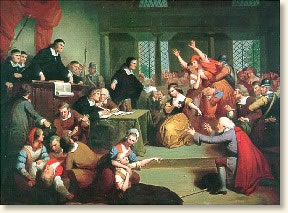
The Puritans, as everyone knows, took witchcraft very seriously. The Devil was a very real presence to them, and they saw the supernatural as dangerous and fraught with evil. They put up signs and markers to ward the Devil off and had frequent prosecutions of witches. In their defense, Puritans hanged, rather than burned, witches, and they usually confined their witch hunts to one or two witches. Only once (in Salem, of course), did a witch hunt spiral out of control in European fashion. Interestingly enough, the Salem witch trials took place in 1692, after witch hunting in Europe had gone into decline. Puritans retains an outdated attitude toward witches.

Cavaliers, the next migration, did not overtly disbelieve in witchcraft, but they regarded accusations with deep suspicion and did their best to discourage them. They were also much less interested in the Devil than Puritan and saw the supernatural, not so much as dangerous or fraught with evil, but as mysterious and inscrutable. Their magical beliefs focused on an attempt to understand it. This led to an interest in astrology and gambling. Virginians were continually betting on just about everything. Gambling was regulated in Virginia, mostly to keep people from gambling away their possessions and becoming burdens on society. Puritans (and Quakers), by contrast, banned all gambling as blasphemous because if God rules the world supreme, there can be no such thing as random chance.

Quakers, at least among the leadership, did not believe in witches or the Devil. They were not, however, always able to suppress beliefs in witchcraft among general populace, and sometime mob violence broke out against alleged witches. Quakers tended to narrow the realm of the supernatural and broaden the realm of the natural. They generally saw the supernatural as kindly and adopted the magic of people who see no menace in the supernatural – spiritualism, seeking to communicate with the dead, and faith healing.

The back country migration was the final one, taking place in the 18th Century when educated people everywhere had stopped believing in witchcraft. Simple and unsophisticated back countrymen retained some vestigial beliefs in witchcraft – how to recognize a witch, how to protect yourself from witches, and even how to put the hex on people – but fighting witches was mostly limited to protective charms. In the many back country outbreaks of violence an vigilantism, Fischer reports, none involved accusations of witchcraft. Their main supernatural beliefs and practices were a set of worldly superstitions, focusing on good luck or bad luck, curing illness and other worldly concerns, like biting off a butterfly head to get a new dress. (For more detail, see Tom Sawyer or Huckleberry Finn). God, the Devil, salvation, spirits and the like played little role.
____________________________________
*Indeed, Fischer often emphasizes the back country culture is not the inevitable result of frontier conditions, but imported from Scotland. His descriptions also make clear that Puritans culture is not the automatic result of Calvinism, but has other origins as well.

Monday, November 21, 2011

Albion's Seed: Old Age and Death

Old age

All four culture honored their elders, but in different ways. The Puritans viewed a long life as a sign of God’s favor and therefore venerated their elders as saints. In very hierarchical Virginia, the main way a person of low rank could achieve status was as an elder. People were taught to respect their elders – meaning not just old people, but anyone older than they were – and betters. Respect due to age equalled and sometimes exceeded respect due to rank. A young gentlemen was expected to respect the authority of an older man of lower rank. Quakers saw their elders as teachers and nurturers, guides to the community. But, an elder’s authority was not as strong as in New England or Virginia; it yielded to the Inner Light. Competition for authority was fierce among elders in the back country. Winners became people of great authority and esteem. Losers were abandoned to lives of lonely destitution.

One ingenious measure of people’s attituded about age is the practice of “age heaping.” This is based on the understanding that, then as now, people tended to fib about their ages. So looking for statistically improbable age groupings (just an incredible number of people who are 29 or 39, compared to 30 or 40) tells us something about a society’s attitudes toward age. No age heaping statistics were availabe for Quakers. My own interpretation of Fischer’s statistics (not necessarily shared by Fischer) is that Puritan and back country attitudes toward age were not so different from our own. Very young people (around 20) wanted to be older than they were. People of intermediate age wanted to be younger. But when people reached the status of honored elders, when, as some wag put it, you stop complaining about your age and start boasting about it, people started to want to be older again. In other words, you do not achieve the status of honored elder until you are recognizably old. The difference was that in the 17th and 18th Centuries, that happened around 60. These days, it happens around 80 or even 90. Virginians had quite a different pattern. Although people around 30 were apparently too young to benefit from elder status, once they approached 40 people had a strong desire to exagerate their ages, which grew stronger with each passing decade. Seniority conveyed authority much earlier in this culture.

Another distinction Fischer did not note is that people fib about their ages much less now than they used to. I can only assume that this is part of a general tendancy to view time with much greater precision now than in the past.

Death

Untimely death was much, much more common in the 17th and 18th Centuries than it is today. People learned to be fatalistic, never knowing when death might strike. But these four cultures were not all fatalistic in the same way.

Puritans lived in constant fear of damnation. Not to fear hellfire was a sure sign of being hellbound. They encouraged people to think often about their death (they called it "daily dying.") Children were encouraged to fear hell, to live in fear that they might die any time, and to stare at the bodies of the deceased to see what their inevitable fate would be. Funerals were austere matters, with sermons that took care not to exagerate the virtues of the dead. And yet, after funeral Puritans held receptions, feasted, and got drunk (one of the few times they allowed such indulgence).

Cavaliers adopted an attitude Fischer calls “stoic fatalism,” in other words, an attitude of oh well, everyone has to die some day. Living lives surrounded by disease and uncertainty, in which anyone could sicken and die at any time, Virginians learned to be dismissive and say that there was no point in crying and carrying on. At the same time, they mourned as much for the loss of loved ones as anyone else. One way of showing grief was by elaborate funerals with pallbearers,
mourning gloves, love scarves, and much feasting, drinking and firing of salutes. Funeral customs were as hierarchical as everything else in their society. People marked funerals with as much ceremony as they could afford. People were buried according to rank, in family cemetaries on the family estate for people who could afford such a plot, with a minimum of ceremony and often no marker for servants and slaves.

If Puritans lived in fear of Hell, Quakers lived in hope of Heaven. Their favored narative of death was the sick person who feared it at first, but moved past fear to welcome death. Families gathered at deathbeds to say farewell and recorded last words for their spiritual significance. Once the event was past, though, the funeral was as quick and austere as possible. They did allow a dinner after, with the bottle circulated – but only twice.

Death by disease was less common in the backcountry than in Virginia, but death by violence was more common. Although the back countrymen, like the Puritans, were Calvinists, they focused less on salvation and more on dying bravely. Funerals had many folk traditions borrowed from Scotland – laying the body on the floor to be in contact with the earth, placing a platter of salt mixed with dirt on the stomach of the deceased, wakes, and gifts to the guests. Everyone was required to touch the body because foul play was often suspected and it was believed that if a murder touched his victim, the body would bleed.

Next: The closely related subjects of religion and magic.