Sunday, December 15, 2013

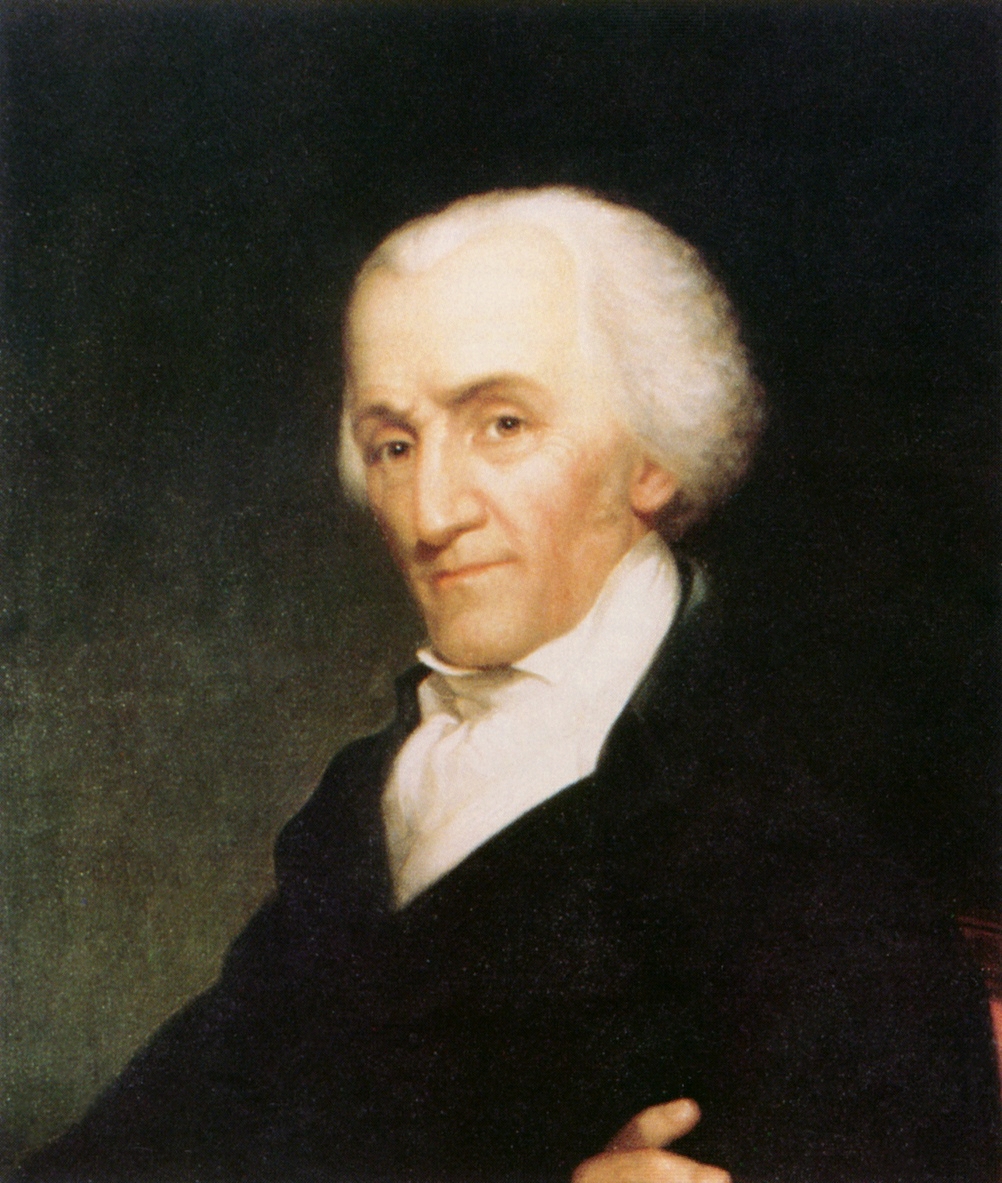
Connecticut Compromisers: Oliver Ellsworth

Since the Great Compromise is also called the Connecticut Compromise, and since Connecticut to this day calls itself the Constitution State because of its critical role in negotiating that compromise, what about the Connecticut delegates?   The Connecticut delegation showed a certain ambivalence on the subject.   When the New Jersey Plan was first introduced, Oliver Ellsworth moved to retain the legislative power in “Congress,” i.e., the old Continental Congress under the Articles, which would have meant that he supported the New Jersey Plan.  Three days later, a vote was taken which plan to adopt and Connecticut broke ranks with the small states and supported the Virginia Plan, effectively dooming the New Jersey Plan.  Yet the very next day Roger Sherman (another Connecticut delegate) was seconding and Connecticut supporting yet another motion to vest all powers in “Congress,” which sounded very much like backsliding to the New Jersey Plan.  At this point, the New Jersey Plan was taken off the table and Connecticut could begin its role in establishing the Connecticut Compromise.

 Ellsworth began by proposing to drop the inflammatory word “national” from the Virginia Plan and simply say “of the United States.”  When the issue of representation in the lower house came up, Connecticut voted to keep representation by states, but when the proposal was defeated, Ellsworth said he was not sorry on the whole.  He proposed conceding proportional representation in the lower house as a ground for compromise with regard to the upper house, which would have representation by states.  
We are partly national; partly federal.  The proportional representation in the first branch was conformable to the national principle & would secure the large States agst the small.  An equality of voices was conformable to the federal principle  & would secure the Small States agst the large. 
The New England states other than Massachusetts might split from the U.S. if not given an equal voice.  The large states’ size alone would give them greater weight despite equality in the Senate; the small states needed equal representation in the Senate to protect themselves.  It would be easier for large states to combine against small ones than vice versa.  Although he favored a stronger government, he warned against attempting too much lest all be lost.  Ellsworth argued that equal representation in the Senate would not unjustly allow the minority to thwart the will of the majority; the minority needed to protect itself from the might of the majority, just as the House of Lords in England protected its own special interest from the majority.  He also appealed to the states’ good faith under the Articles of Confederation to allow all states an equal voice.  

Ellsworth was thus a leading advocate of the Great Compromise.  When Morris and King proposed the final form of that compromise, that each state have an equal number of Senators, but that they vote as individuals instead of by states, Ellsworth made the conciliatory remark that he had always approved of voting in that mode.

Unlike Dickinson and Franklin, Ellsworth was not generally a nationalist by inclination, and even after the Great Compromise was reached, Connecticut remained one of the most skeptical states about increasing federal power.  He wanted the national legislature to have only a few great, national objects and believed that a federal veto of all states laws would be so slow and awkward that it would require federally appointed state governors.*  He opposed allowing federal intervention in state rebellions without an invitation from the state, although he would allow the state executive to make the invitation if the legislature were unable to meet He also opposed giving the general government authority to make rules for the militia unless in actual federal service or if states neglected their militias, saying that without their militias states would “pine away to nothing.”  Giving the general government over a part of the militia would merely weaken the rest of it, and the people of different states would never submit to the same discipline.  Alternately, he would allow a common rule of discipline, so long as the states were the ones to actually carry it out.  His views on pay for the national legislature changed over time.  At first he favored pay by states, since the general scale of pay was different in different states.  He later proposed having at least the Senate paid by the states so they would have confidence in the Senate.  In the end, however, he decided that payment by the states would make Congress too dependent on them and that legislators should be paid from the national treasury.  Finally, he believed that ratification should be by state legislatures instead of by conventions.  He granted that if any state legislature considered itself incompetent to ratify the Constitution, it could call a convention instead, but he did not trust conventions.  If legislatures were competent to ratify the Articles of Confederation and all subsequent changes to it, why not the Constitution, which he regarded as a compact among states.

            Oliver Ellsworth had gone home by the end of the convention and so was not present to sign.  However, he was one of the strongest supporters of ratification and wrote a series of articles under the pseudonym of Landholder that were considered some of the best arguments in favor of the Constitution.


___________________________
*It was in response to this comment that Charles Pinckney said he did think state executives should be federally appointed,

Saturday, December 14, 2013

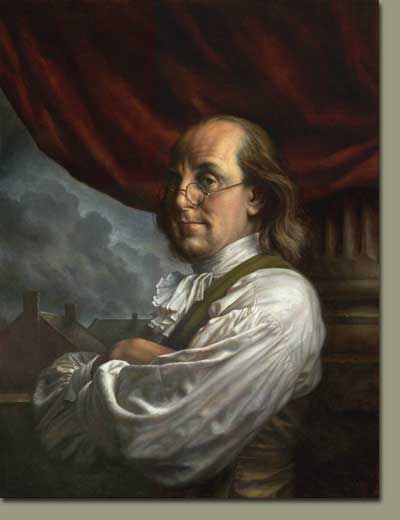
The Most Famous Compromiser: Benjamin Franklin

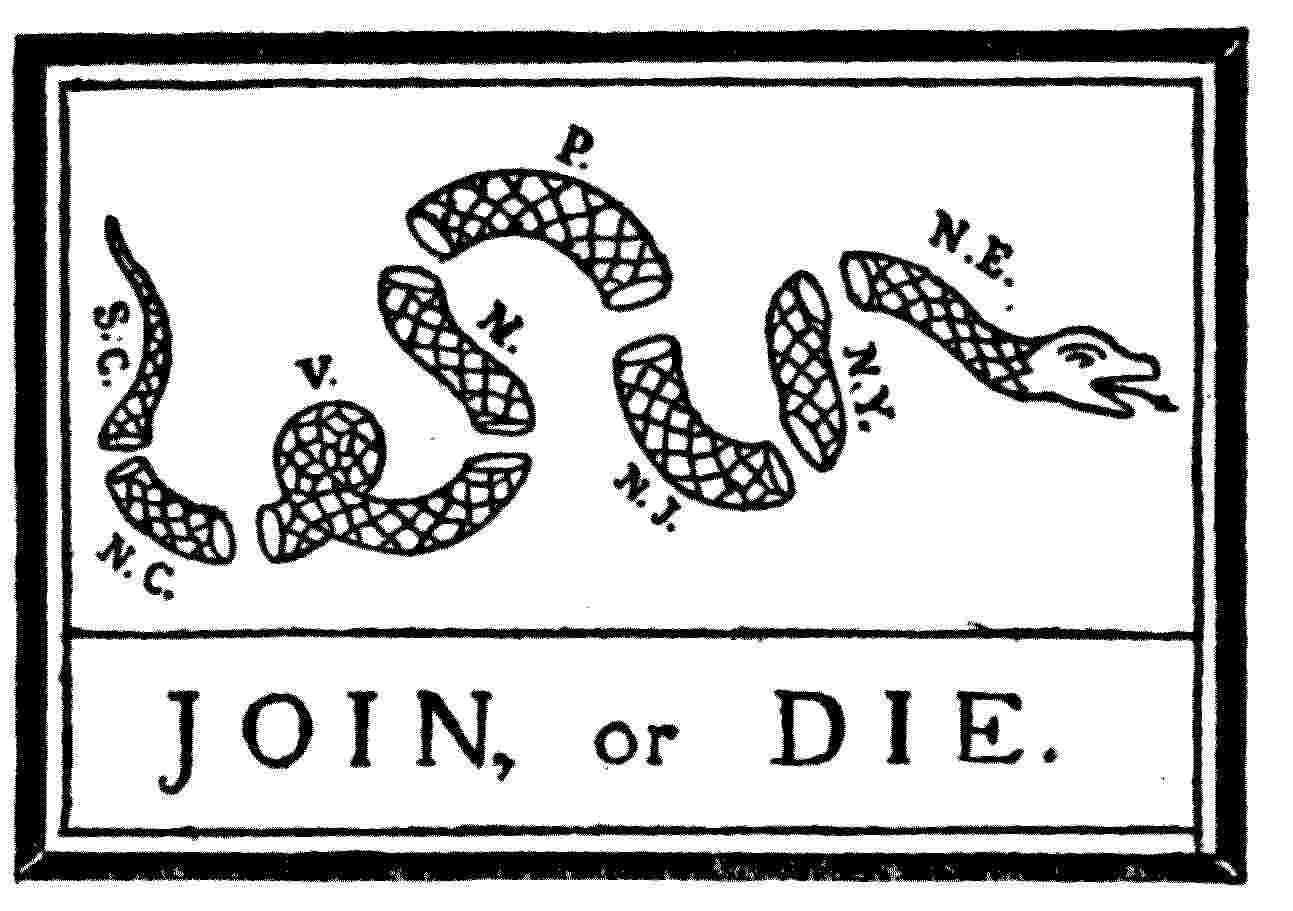
Benjamin Franklin was, no doubt, the most cosmopolitan member of the Convention, the first American of international renown, a member of the Royal Society, many colonies’ former agent in England and the former U.S. minister to France, where he played a critical role in treaty negotiations and mingled with the top literatti (in England as well).  Franklin had been urging the colonies to “Join or Die” since the 1750’s, so he would seem a natural nationalist, who would urge his fellow delegates to look beyond their local interests to the good of the whole.  And no doubt this was his natural inclination, but instead his statesmanship took the form of resisting that natural inclination and working, instead, to reassure the small states and reach the compromise that save the Constitution.

 He indicated his natural inclination, saying he would prefer to see each representative consider himself a representative of the whole rather than an agent for a particular state, and it would not matter how representation was apportioned.  Since this was not realistic, he favored representation in proportion to population and voting as individuals, rather than by states.  He did not see this as threatening to swallow up the small states any more than Scotland was swallowed up by a union with England.  In the interest of equalizing states, he even offered to give up a part of Pennsylvania to Delaware and New Jersey, but, he said, this would not be a good long-term solution since populations are constantly shifting, which would require state boundaries to be constantly shifting as well to maintain equality.

As a compromise, he proposed for the smallest state to volunteer to provide whatever quota of money or force it could afford and have all others agree to furnish an equal portion.  Congress would then consisted of an equal number of representatives from each states, who would vote as individuals, rather than by states.  If more supplies were required, Congress could make up the difference by requesting voluntary contributions from the larger and more powerful states, which he believed they would be willing to furnish.  He apparently considered equal representation by states as just so long as each state was financing the system equally.  What he considered most unjust was the system of voting by states.  Under that system, the majority of each state’s delegation, in effect, cast that state’s vote.  Since larger states generally had larger delegations than small ones, it would be possible for a measure favored by a bare majority of the seven smaller states’ delegations to pass, even though unanimously opposed by all the large states, and a distinct minority of members of the legislature could prevail over the majority.

This proposal was made when the Convention was debating whether representation would be by population or by states in either house, or even whether to have two houses at all.  Later, when it became apparent that there would be two houses and that the lower house would be proportional to population, he proposed a similar system for the Senate:
If a proportional representation takes place, the small States contend that their liberties will be in danger.  If an equality of votes is to be put in its place, the large States say their money will be in danger.  When a broad table is to be made, and the edges of the plank do not fit, the artist takes a little from both, and makes a good joint. 
He proposed instead to have an equal number of representatives per state in the Senate, each voting as individuals.  In all matter involving the sovereignty of individual states or the overall powers of the central government, each state would have and equal vote.  In all matters related to spending, states would have a vote in proportion to their contribution to the treasury.  In fact, however, the large states never said anything to indicate that they were resisting equality in the Senate for fear that it would tax then excessively; their arguments were based on the principle that every person should be equally represented and the practical argument that unless representation was in proportion to a state’s actual importance, the government would be hopelessly weak.

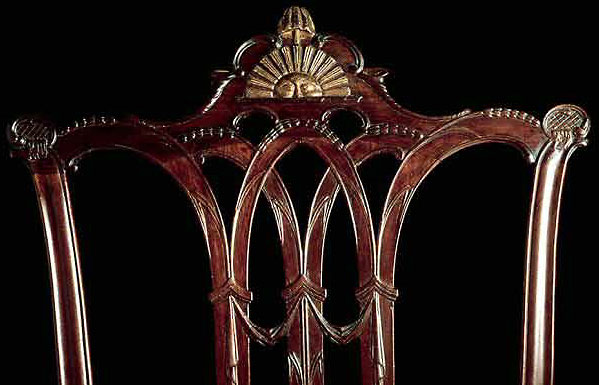
Franklin served on the committee that first proposed the Great Compromise, to have states equally represented in the Senate in exchange for giving the House sole authority to originate money bills.  This compromise was apparently his proposal,  and he made clear that he considered these two conditions dependent on each other and would not support them separately.  His main other contributions on centralization were to propose a federal authority to cut canals, and, at the end, to urge everyone to support the Constitution, despite having some doubts abouts it because a stronger government was clearly needed (9/17/87, pp. 653-654).  As the delegates proceeded to sign the Constitution, Benjamin Franklin gave the most famous statement of then Convention.  George Washington, presiding over the meeting, had been sitting in a chair with a sun painted on it:
Washington's Chair
I have, said he, often and often in the course of the Session, and the viscisitudes of my hopes and fears as to its issue, looked at that behind the President without being able to tell whenter it was rising or setting; But now at length I have the hapiness to know that it is a rising and not a setting sun.

Compromisers, Including John Dickinson

This is, in many ways, the critical group, the ones who supported the Virginia Plan but favored giving each state equal representation in the Senate.  If the moderate nationalists were the most creative members of the Convention, the compromisers were the most statesmenlike.    The moderate nationalists made the original proposal that became the Constitution; the compromisers saved the convention from breaking down and made its success possible.   Overall, compromisers varied greatly in the amount of centralization they favored, ranging from ones who accepted the Virginia Plan only reluctantly, preferring the New Jersey Plan, to ones who only reluctantly agreed to equality in the Senate.  The one issue of centralization all but Benjamin Franklin agreed on was that they opposed states giving up control of their militias.

John Dickinson (Delaware).  The Great Compromise is also called the Connecticut Compromise because it was supported by the Connecticut delegation, but the honor of being first to propose it goes to John Dickinson of Delaware, and he proposed it, no less, on June 2, the end of the very first week of the Convention.  He argued on that date that it was essential to the stability of the country to preserve the states.  Furthermore, “He hoped each State would retain an equal voice in at least one branch of the National Legislature, and supposed the sums paid within each State would be a better ratio for the other branch than either the number of inhabitants or the quantum of property.”  No one at the time paid much attention to the proposal.

Dickinson showed another extraordinary piece of insight very early in the convention when he proposed that the lower house be elected by the people directly and the upper house by the state legislature, the system ultimately adopted.  Nonetheless, Dickinson’s proposals went largely unheeded, as large state delegates resisted equality in the Senate and small states resisted the entire system.  When the small states proposed the New Jersey Plan, Dickinson told Madison, “You see the consequences of pushing things too far.  Some members from the small states whish for two branches in the General Legislature, and are friends to a good National Government; be we would sooner submit to a foreign power than submit to be deprived of an equality of suffrage in both branches of the legislature, and thereby thrown under the domination of the large States.”  (?).


Dickinson showed himself to be a nationalist in general, other than his support for equality in the Senate.  He firmly supported having the national legislature paid from the national treasury to keep it independent of the “prejudices, passions, and improper views” of state legislatures.  He even favored a Congressional veto of state laws, saying that it was impossible to draw a line between proper and improper use of the veto and either the national or state governments must be exposed to the risk of being injured by the other.  Like Madison, he thought there was greater danger of encroachment by the states.  He also favored establishing federal courts and opposed any guaranty of existing state borders.  Finally, he favored allowing the federal government to intervene in case of a rebellion in a state without the state’s request, or at least with only the request of the executive, rather than the legislature. 

Sunday, September 29, 2013

Moderates: Elbridge Gerry of Massachusetts

Probably the best known of the moderates is Elbridge Gerry, memorialized in the word Gerrymander.  Like other moderates, Gerry favored a government with authority over individuals and opposed giving the states equal representation in the Senate, but generally distrusted centralization.  His most nationalistic pronouncement came up during the debate on equality in the Senate:
[W]e never were independent States, were not such now, & never could be even on the principles of the Confederation. The States & the advocates for them were intoxicated with the idea of their sovereignty. He was a member of Congress at the time the federal articles were formed. The injustice of allowing each State an equal vote was long insisted on. He voted for it, but it was agst. his Judgment, and under the pressure of public danger, and the obstinacy of the lesser States. The present confederation he considered as dissolving. The fate of the Union will be decided by the Convention. If they do not agree on something, few delegates will probably be appointed to Congs. If they do Congs. will probably be kept up till the new System should be adopted. He lamented that instead of coming here like a band of brothers, belonging to the same family, we seemed to have brought with us the spirit of political negociators [sic].
This appears to be an endorsement of the general concepts of the Virginia Plan -- a government with authority over individuals, representing the people as individuals. Gerry served in the committee that first proposed the Great Compromise.  He grudgingly assented in its report, saying, "We were however in a peculiar situation. We were neither the same Nation nor different Nations. We ought not therefore to pursue the one or the other of these ideas too closely."  Unlike some other moderates, Gerry did see giving the House sole authority to initiate money bills as a significant concession.  If Senators voted as individuals instead of by states, he would reluctantly support the compromise, rather than risk seeing the country split apart.

Otherwise, Gerry was deeply mistrustful of the central government and outspoken in his opinions.  Already distrustful of the whole process, he called federal control of the militia, "[T]he last point remaining to be surrendered. If it be agreed to by the Convention, the plan will have as black a mark as was set on Cain." He would "as lief let the Citizens of Massachussets be disarmed, as to take the command from the States, and subject them to the Genl. Legislature. It would be regarded as a system of Despotism."  Although shaken by Shays Rebellion in Massachusetts, he was "agst. letting loose the myrmidons of the U. States on a
State without its own consent."  Unlike other moderates, Gerry wanted federal representatives to be paid by the federal government, rather than the states.  On the other hand, he opposed allowing federal authority to establish forts in states.  He opposed dividing states.

In the end, Gerry refused to sign the Constitution.  Among his objections, he listed the power of Congress to regulate elections, the danger that Congress' authority to regulate trade might include licensing monopolies, the power of the legislature to make all laws "necessary and proper," and to raise money and armies without limit.

Sunday, September 15, 2013

Moderates: Charles Cotesoworth Pinckney and John Rutledge

Charles Cotesworth Pinckney (South Carolina):


Charles Cotesworth Pinckney, also of South Carolina, was a cousin of Charles Pinckney.  Madison distinguished them by referring to him as "General Pinckney."  When Randolph first proposed the Virginia Plan, General Pinckney questioned whether the convention had the authority to propose an entire new system and seconded a motion that instead of calling for a "national" government simply called for a "more effective" government "to carry into execution the Design of the States."  He wanted to leave "a considerable share of power in the States," and proposed to have the state legislatures elect the national legislature, saying the states would be jealous and try to thwart the national government unless given participation in it.

On the nationalist side, he appears to have opposed giving each state equal representation in the Senate, saying that giving the House sole authority to originate money bills was not significant concession, although he also opposed disbanding the Convention over the issue.  His most nationalist position was to favor federal federal regulation of the militia.  Speaking from experience in the Revolutionary War, General Pinckney said that uniformity was essential, and that states could not be counted upon to maintain proper discipline.  Furthermore, he saw no reason to distrust the general government on this issue at least, and favored federal control of the entire militia.

On the other hand, he wanted each state to be allowed to decide which ports would be ports of entry (ports involved in foreign trade), and wished to allow national representatives to hold state office, in order to increase state influence in the federal government.

John Rutledge (South Carolina):
John Rutledge did not like the vague proposal in the original Virginia Plan to give the federal government power in all area for which the states were "incompetent."  He preferred a more specific designation of what those powers should be.  He did, however, believe that the federal Congress would have enough business to require it to meet every year.

Like the rest of the South Carolina delegation, Rutledge opposed equal representation in the Senate.  Instead, he proposed giving each state one, two, or three delegates, depending on their "relative importance."  He apparently favored making representation of all states in both houses proportionate to their tax quotas.  When the convention reached its ultimate deadlock on Senate representation, he somewhat ambiguously said:
[He] could see no need of an adjournt. because he could see nochance of a compromise. The little States were fixt. They had repeatedly & solemnly declared themselves to be so. All that the large States then had to do, was to decide whether they would yield or not. For his part he conceived that altho' we could not do what we thought best, in itself, we ought to do something.
This appears to be a grudging agreement to the Great Compromise. Rutledge did not favor giving the federal government power to establish trial courts or regulate elections.

Saturday, August 31, 2013

Moderates: Hugh Williamson and Pierce Butler

Like moderate nationalists, the moderates favored the Virginia Plan over the New Jersey Plan and opposed equal representation in the Senate.  However, while moderate nationalists looked upon a stronger central government as positive and creative, the moderates saw threat as well as promise in it.  They agreed that that the central government should have authority over individuals as well as states, but they wanted to preserve more state agency in it.  In particular, moderates indignantly opposed the federal veto of state laws.  Most also believed that states should pay federal representatives.  Elbridge Gerry of Massachusetts (yes, he of the Gerrymander) is the best known of the moderates today.  The others came from the Deep Southern states of North Carolina or South Carolina – medium states that aspired to be large.

Hugh Williamson (North Carolina):

Like others in this category, Hugh Williamson's most significant nationalist position was that he opposed equal representation in the Senate.  Just as states give greater representation to larger counties, Congress should give greater representation to larger states.  He was willing to see the issue sent to committee, but he did not like the proposed Great Compromise, as he did not consider giving the House sole authority to originate money bills as any significant concession by small states.  On the other hand, after the Great Compromise was reached, when some delegates proposed to allow the Senate to originate money bills, he threatened to take back equality in the Senate.

In most other regards, Williamson was less of a nationalist.  Like most moderates, he believed members of Congress should be paid by states.  He considered the happiness of the people to depend on the continued existence of states and believed that if state officials were required to take an oath to uphold the federal constitution, then federal officials should be required to take an oath to uphold state constitution.  When Gouverneur Morris made the rash remarks quoted above, Williamson attempted to be conciliatory.  “He did not conceive the [Mr. Gov’r Morris] meant that the sword ought to be drawn against the smaller states.  He only pointed out the probable consequences of anarchy in the U.S.”

Pierce Butler (South Carolina):

South Carolina had four delegates who made a significant contribution to the convention, more than any other state.  One of these was Pierce Butler.  Butler had initial misgivings about the Virginia Plan.  He feared that it took too much power from the states, particularly with the vague phrase giving the National Legislature power “in all cases to which the State Legislatures were individually incompetent,” which could run into an extreme and destroy “all balance and security of interests among the States which it was necessary to preserve.”  He did, however, believe that a bicameral legislature and separations of powers would make it safer to give increased powers to the new government than the old Continental Congress.  Like other moderates, Butler opposed equal representation in the Senate and did not consider giving the House sole authority to originate money bills to be a significant concession in exchange.*   However, he did not want to base the Senate on population, but on wealth.  Population was too changeable to be a fixed standard, whereas property was the great object of government, the great cause of war and the great means of carrying it on.  Like Williamson, he favored having states pay Congressional representatives.  Butler did not think federal trial courts (as opposed to appellate courts) were necessary.


Though generally distrustful of the central government, Butler favored submitting the whole militia to the general authority, which had the care of the general defense.  That last, incidentally, is part of a general pattern by Butler that I hope to discuss later – although general distrustful of the central government, he made an exception wherever military security was at stake.

*This was a concern among most of the South Carolina delegation.  Apparently the South Carolina legislature limited money bills to the lower house, and serious problems arose as a result.

Saturday, August 17, 2013

Moderate Nationalists: Charles Pinckney of South Carolina

Given the state's later history, it may seem surprising that the final moderate nationalist was Charles Pinckney of South Carolina.  Yet the South did not become firmly established as a bastion of state's rights until it became clear that it would be a permanent minority region.  At the time of the Constitutional Convention, the South was undoubtedly a minority region, but it was not clear that its status would be permanent.  In the earlier stages of the Convention, when the larger states supported the more centralized Virginia Plan and the small states the less centralized New Jersey Plan, three states consistently voted along with the large states of Virginia, Massachusetts and Pennsylvania for a more centralized government -- North Carolina, South Carolina and Georgia.  The answer appears to be that population was growing more quickly in the South than the North, so the South expected demographics to favor it.  Besides, Delaware, New Jersey, Connecticut and Maryland were geographically small and therefore had little room to grow.  The Deep Southern states had plenty of land to expand into.  Though not large states, they voted as aspiring large states.  The South became firmly committed to states' rights only when industrial development in the North gave it an ever-growing population advantage, making clear that these aspirations would not come about.

South Carolina had four major delegates, more than any other state.  Interestingly, although the overall delegation consistently voted for the more centralized Virginia Plan and against equality in the Senate, only Charles Pinckney* was its only delegate who truly rates in the nationalist category.  Pinckney appears to have proposed his own plan of government, but no record survives of what it was.  The one thing that is clear about the plan is that he did not believe the national legislature would be able to make good laws for the whole, so states must remain to "prevent confusion."

Like other moderate nationalists, Pinckney opposed giving all states equal representatives in the Senate, but believed the full proportionality would make the Senate too large.  Instead, he proposed having each state have one, two, or three Senators, depending on its size.  Interestingly, at least one reason he opposed full equal representation was so that the southern states could protect their interests.  Alternately, he proposed each state having half as many Senators as Representatives (odd numbers rounded up).  He did not see giving the House sole authority to originate money bills as a serious concession in return for equality in the Senate.

Pinckney also favored giving Congress the power to charter corporations; establish seminaries of learning; grant patents; create public institutions to encourage agriculture, commerce, trades and manufactures; but not to regulate elections.  However, his strongest expression of nationalism was his support for a federal veto of state laws.  He considered such a rule indispensably necessary to defend the national prerogative and keep states in due subordination, and to keep them from violating federal laws and treaties, which they had done before.  Long after everyone else had abandoned the federal veto, Pinckney once again proposed it, this time by a 2/3 vote.  This proposal was met with many objections, including how it would be done.  Would all state laws be transmitted to the national legislature, would they be repealable by the national legislature, or would state executives be federally appointed, with such a veto.  "Mr. PINKNEY declared that he thought the State Executives ought to be so appointed with such a controul, & that it would be so provided if another Convention should take place."  Apparently, then he joined with Hamilton in favoring federally appointed state governors with an absolute veto, similar to royal governors of colonies.  This point never even reached the debate stage.

NEXT UP:  Moderate nationalists.