The issue of centralization consisted of a number of sub-issues. Would the central government have power over individuals, or only over states? What would its exact powers be? Would representation be by population or by states? Would federal law simply be supreme, or would there be a congressional veto of state laws? Who would control the western lands, the central government, or the states? Could the large states be divided into smaller states?
These were the big issues addressed early on. Later, more detailed issues arose. Under the Articles of Confederation, states were forbidden from keeping regular troops (i.e., full time professional soldiers), but had full control over their militias (reserves). The ban on states keeping regular troops continued, but what authority would the central government have over state militias? Would it be authorized to intervene in case of a rebellion against state government? And finally, there was the issue of how the Constitution would be ratified, by state legislatures, or by special conventions. Ratification by state legislatures would suggest that the new government was still chartered by the states. Ratification by special conventions would mark it as a people's government. And then there was the question of how many states would have to ratify for the new Constitution to be effective.
The delegates had a wide spectrum of views on centralization, but might be divided into several sub-groups.
Extreme nationalists. These were the ones who wanted to abolish separate states altogether or at least reduce them to administrative departments of a unitary system. There were only two of these, George Read (Delaware) and Alexander Hamilton (New York).
Moderate nationalists. These can be roughly classified as the ones who supported the Virginia Plan, opposed equality in the Senate, and favored ratification by conventions instead of state legislatures. They generally belonged to the large states of Massachusetts, Virginia and Pennsylvania (with the exception of Charles Pinckney, of South Carolina). These delegates were generally the most active, important, and creative members of the Convention.
Moderates. Like moderate nationalists, moderates favored the Virginia plan over the New Jersey Plan. and opposed equality in the Senate, but they favored less power for the central government than moderate nationalists and wanted to preserve more sovereignty for the states. In particular, they indignantly opposed federal veto of state laws. Most favored having the national legislature paid by the state governments, which would obviously increase state influence over their representatives. While moderate nationalists tended to see a stronger central government as positive and creative, moderates saw both promise and threat in it. Moderates included Elbridge Gerry of Massachusetts and numerous delegates from the South.
Compromisers. This is, in many ways, the critical group, the ones who supported the Virginia Plan but favored giving each state equal representation in the Senate. If the moderate nationalists were the most creative members of the Convention, the compromisers were the most statesmanlike. The moderate nationalists made the original proposal that became the Constitution; the compromisers saved the Convention from breaking down and made its success possible. Overall, compromisers varied greatly in the amount of centralization they favored, ranging from ones who were reluctant to accept the Virginia Plan to ones who were reluctant to accept equality in the Senate. But it was in their willing to make compromises on what they wanted that they made success possible. Benjamin Franklin was of this group. Its members drew heavily from Delaware and Connecticut.
Moderate advocates of state sovereignty. These were the advocates of the New Jersey Plan, who initially resisted the Virginia Plan even if given equal representation in the Senate, but dropped all resistance and supported the Constitution when the Great Compromise was reached. They tended to be from small states, particularly Delaware and New Jersey. Yet when the Constitution was finally proposed, Delaware and New Jersey were among the first to ratify, and with the least controversy.
Extreme advocates of state sovereignty. These were the few irreconcilables who held out to the last for a mere strengthening of the Articles of Confederation and never agreed to the Constitution. One (Luther Martin) was from Maryland and two from New York.
Next up: I will describe the delegates one by one.
I am a lawyer with an amateur's interest in U.S. history. This blog will be about various episodes in U.S. history, with an emphasis but not limitation to law. WARNING: CONTENTS WILL BE TOO OBSCURE AND DULL FOR THE GENERAL PUBLIC, BUT TOO SUPERFICIAL FOR SERIOUS SCHOLARS.
Saturday, April 20, 2013
Sunday, April 7, 2013
The Constitutional Convention and Centralization: A Chronology
In high school civics class, I was taught that the most divisive issue at the Constitutional Convention was between large states, that wanted representation to be proportionate to population, and the small states that wanted all states to have an equal number of representatives. The issue was finally resolved with the Great Compromise -- proportional representation in the House; equal representation in the Senate and from then on all quickly resolved.
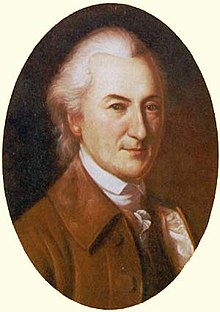
This account is not exactly false, but it is incomplete. As discussed in my previous post, initially the large states backed the more centralized Virginia Plan and small states, fearing that the new government would be dominated by large states, supported the less centralized New Jersey Plan. Charles Pinckney of South Carolina was dismissive of their stated concerns for state sovereignty, saying, "Give N. Jersey an equal vote, and she will dismiss her scruples, and concur in the Natil. system." So it turned out to be. Connecticut switched votes to support the Virginia Plan in late June, and from then on the controversy was over whether representation would be by population or by states. The Great Compromise was first proposed by John Dickinson of Delaware about a week into the Convention. No one paid much attention at the time, but he does deserve credit for being the first to make the suggestion. Representation by population was adopted on June 29, about ten days after adopting the Virginia Plan, and remained uncontroversial from then on. But the issue of representation in the Senate remained bitterly contested, threatening to derail the entire convention, with large states holding out for some alternative to full equality of states in the Senate, and small states refusing to budge.
The break finally came on July 16, when Edmund Randolph proposed that the Convention "adjourn." William Paterson took this to mean ending the Convention altogether and confessing to failure. Randolph then backed off, assuring him that he meant only to adjourn for the day to discuss matters off the record. Meeting in private, it became clear that the small states believed they had made all the concessions that could be made and that they would not yield on this point as well. The large states then backed down, and the Great Compromise was unofficially reached. The next day, the delegates changed the subject to allow heated tempers to cool. A week later, Gouveneur Morris of Pennsylvania and Rufus King of Massachusetts, both large state delegates who had opposed equal representation in the Senate, jointly proposed that each state have an equal number of Senators, but that they vote individually. (Under the Articles of Confederation, voting had been by states). Oliver Ellsworth of Connecticut endorsed voting individually, and the spirit of amity covered all. The Great Compromise had been reached. Small state resistance to a strong central government ended, and small state representatives became the leading supporters of a strong federal government. Debate continued for another two months -- partly on what specific powers the central government should have, and especially over how to choose a President. But the Convention was never again in serious danger of failing altogether.
Saturday, March 30, 2013
The Constitutional Convention and Centralization: The Virginia and New Jersey Plans
The Constitutional Convention was originally only authorized the strengthen the Articles of Confederation, in particular, to give the central government the power to tax and regulate foreign trade. Instead, the Virginia delegates met before the Convention and developed the Virginia Plan, a whole new system of government that was ultimately adopted and became -- in extremely modified form -- the U.S. Constitution. That Plan is generally considered to have been primarily the work of James Madison, but his fellow Virginian Edmund Randolph introduced it, and the plan was treated throughout the convention as Randolph's plan.
The Virginians saw only one solution to the young country's problems -- to abandon the old confederated system in favor of what is now called federalism -- a system in which both the central and local governments are independently chartered, and each exercises direct authority over individuals, including the authority to collect taxes, raise armies, and try offenders against federal (but not state) laws. Direct authority over the individual was proposed immediately and not much disputed among the delegates, which obscures just how sharp a break it was from any previous "federated" system. As Alexis de Tocqueville put it in the early 19th Century:
In all the confederations that preceded the American Union the federal government, in order to provide for its wants, had to apply to the separate governments; and if what it prescribed was disagreeable to any one of them, means were found to evade its claims. If it was powerful, it then had recourse to arms; if it was weak, it connived at the resistance which the law of the union, its sovereign, met with, and did nothing, under the plea of inability. . . . In America the subjects of the Union are not states, but private citizens: the national government levies a tax, not upon the state of Massachusetts, but upon each inhabitant of Massachusetts. The old confederate governments presided over communities, but that of the Union presides over individuals. Its force is not borrowed, but self-derived; and it is served by its own civil and military officers, its own army, and its own courts of justice.Other delegates, who considered the Virginia Plan too centralized, proposed their rival New Jersey Plan, introduced by William Paterson of New Jersey, which proposed merely to strengthen the Articles of Confederation, rather than introduce a new form of government.
The differences between the Articles of Confederation, the Virginia Plan and the New Jersey Plan were as follows:
|
Articles of Confederation
|
Virginia Plan
|
New Jersey Plan
|
|
Unicameral legislature
|
Bicameral legislature
|
Unicameral legislature
|
|
Each state has one vote
|
Representation in both houses apportioned by free population or by
quota of contribution
|
Each state has one vote
|
|
Delegates elected by the state legislatures
|
Lower house elected by the people; upper house elected by the lower
house
|
Delegates elected by the state legislatures
|
|
Federal government limited to foreign and military matters, coining a
common currency, and resolving border disputes among the states. Money and troops raised by the states
|
Federal government to have power to legislate “in all cases to which
the separate states are incompetent, or in which the harmony of the United
States may be interrupted by the exercise of individual legislation”
|
Adds to federal government the power to regulate foreign and
interstate trade, tax imports, make a stamp tax, collect taxes if states fail
to pay their quotas, and establish a uniform system of naturalization
|
|
All state bound by federal statutes and treaties, but federal
government has no enforcement power
|
Congress may veto all state laws contrary to federal law
|
Federal law to be supreme, anything in state law
notwithstanding. Federal government
authorized to use force against state that defy federal law.
|
|
No federal executive. All
enforcement powers rest with the states
|
Federal executive elected by the legislature
|
Federal executive elected by the legislature
|
|
All alterations must be approved by all 13 states
|
Some system of amendment called for
|
Some system of amendment called for
|
The Constitutional Convention and Centralization: Are We National or Federal
One of the outstanding achievements of the Constitutional Convention was the invention of federalism in its modern sense. Prior to the Constitutional Convention , governments were either what political scientists today would call "unitary" (or people at the time called "national") or "confederated" (or what people at the time called "federal.") In a unitary system, the central government is clearly supreme and local governments are mere administrative divisions. In a confederated system, the central government is the creation of its members, joined in a common defense. The central government has no direct jurisdiction over individuals, only over its member states.
The United States under the Articles of Confederation was a confederated government. The central government consisted of the Continental Congress, which could legislate for the whole, but left all enforcement to the states. Each state sent two to seven delegates to Congress, but delegation could cast only one vote, on behalf of the state. Delegates were elected by state legislatures for one-year terms and bound by instructions by the states they represented, more like ambassadors than a true legislature. The central government financed itself by determining how much money it needed, and assigning each state a proportionate quota of the total. Each state was allowed to raise the money as it wished; the central government had no power to collect taxes. The same rule applied to raising armies -- each state was required to raise troops in proportion to its population, but the central government had no power to raise forces itself. Not too surprisingly, states regularly failed to proved their full quotas of money or soldiers. Furthermore, although legislation passed by the Continental Congress was theoretically binding, it had no enforcement powers, so states could regularly defy its will. The central government had full authority over foreign affairs, and sole authority to negotiate treaties, including trade treaties. However, with no power to regulate foreign trade, states regularly defied the terms of such treaties.
It was generally agreed that this was an unsatisfactory arrangement and that a stronger central government was needed. But what form would it take?
Saturday, March 23, 2013
Introduction to the Constitutional Convention: What Was Truly Groundbreaking
Civics textbooks today are mistaken when they imply that the Constitutional Convention invented the separation of powers into executive, legislative and judicial. In fact, as we have discussed, the concept originates with Montesquieu and was well established at the time.
At the same time, the Constitutional Convention had other groundbreaking achievements that civics textbooks today overlook.
The most impressive was simply in establishing a stable popular government. Contemporary Europe had very little to offer as models -- tiny Switzerland was about all there was. The main examples of popular government contemporary Europeans had to look upon were in ancient Greece and Rome -- and these were examples that tore themselves apart with factional strife. Popular government was generally seen as dangerously unstable and prone to self-destruction.
Admittedly, the Founders had an advantage over contemporary Europeans. They had another role model to look to -- themselves. All the colonies had practices elective, popular government to some degree, though most were only partial, with a considerable amount of authority in hands of colonial officers appointed in Britain.* Upon declaring independence, the states threw off the colonial yoke and established their own governments. The Convention therefore had the guidance of a century of semi-popular colonial government and a decade of fully popular state government to use as role models.
This leads to another groundbreaking achievement -- the invention of a written constitution. The term "constitution" had long been in use to mean the general institutions and rules of government, but it differed from a "constitution" in the modern sense in not being written down anywhere so that no one could prove what the constitution really was. Written plans of government dated back at least to the Middle Ages, when the king could issue charters to cities, setting forth their forms of government. This system continued in the colonies, which also received charters laying out their forms of government. All these charters, however, were issues by the king and could be withdrawn by the king. The practice of a written plan of government, issued by the people to themselves is an American invention, invented by the states during the Revolutionary War, and adopted at the federal level in 1787. It is often said the the U.S. Constitution is the oldest written constitution in use. A few state constitutions can challenge its claim to the honor, but as a national constitution, the U.S. Constitution is necessarily the worlds oldest, because written constitutions had not been invented before.
Closely related to the concept of a written constitution is the idea of judicial review, i.e., that courts can declare acts of the legislature unconstitutional. This, in turn, grows out of the older English concept of common law -- that judges are law makers. In England dating back to the Middle Ages, courts had been required to follow precedent set down by higher courts. Precedents, in other words, carried the force of law, meaning that judges made binding law. (Requiring judges to follow the precedents set by appellate courts created a "common law" throughout England, thus the name common law). Common law precedents could be overturned by legislative enactments, i.e., statutes. But the English system made no distinction between constitution and ordinary legislation. The will of the legislature, as set forth in statutes, always trumped the will of the courts as set forth in common law.
This was not the case in the colonies, which had charters that were higher law than ordinary legislation. And over time, the colonists developed the concept of a "constitution" that stood above ordinary legislation. The question then arose as to who decided which legislation was and was not constitutional. The answer turned out to be the courts. Contrary to what civics textbooks, this power was not illegitimately usurped by the courts, but was part of the plan from the start. It had occasionally be practiced by state courts even before the U.S. Constitution was prepared, and was discussed in the Convention and in the Federalist Papers. And it is an American invention.
Finally, the Constitutional Convention invented federalism, as the concept exists today -- two levels of government, both with direct authority over individuals, and neither chartered by or dependent on the other. I will discuss this at length in my following essays on centralization.
There are three main ways one can look at the Constitutional Convention. One is a chronological look at the process of the Convention tracing events as they took place and seeing how they Constitution developed and took shape. Another is is to look at the Convention issue by issue, see what issues were raised, what positions were taken, and what compromises were reached. A third is to look at the delegates as individuals and try to determine what each one believed in and stood for.
The approach I intend to take is primarily the third approach, to look at the individual delegates (at least the ones who were major participants) and see what each one believed in and stood for. I will break it down by the three main issues at stake -- the degree of centralization of the new government, the degree of democracy it should have, and issues that divided northern and southern states. For each of these main issues, I will give an overview and then describe the speeches and actions of the delegates, individual by individual, on the subject.
__________________________________________________
*Details of state governments will be discussed later. Connecticut and Rhode Island were unique in having fully autonomous and elective government, even in colonial times.
Sunday, March 3, 2013
Introduction to the Constitutional Convention: An Overview
All right. Now we can begin what I originally started this blog to discuss: The adoption of the U.S. Constitution.
From May 29 to September 17, 1878, delegates from twelve states (all except Rhode Island) met in Philadelphia, originally intending to strengthen the Articles of Confederation. Instead, they ended up drawing up an entire new system of government -- the U.S. Constitution, which has survived with some modifications to this day.
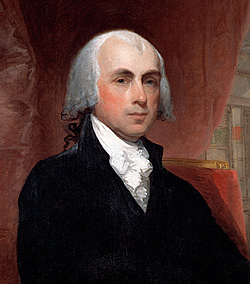
| James Madison |
Reading over his notes, several things catch the attention. One is how readable the basic notes are. Most writing from the time have a stiff and elaborate tone that makes them difficult for the modern reader to struggle through. Perhaps it should not be surprising that Madison's notes are more accessible -- they are, after all, accounts of speeches, some planned in advance, but most relatively spontaneous. As such, they are less formal than written language. Another is Madison's frequent use of abbreviations. This should not be too surprising, given that he was taking down notes as people were speaking and would naturally have trouble keeping up. Another is that, in those days before Spellcheck, Madison's spelling and punctuation often leave much to be desired. Given the circumstances, this is entirely understandable, but somehow there is something reassuring in the thought that the "assembly of demigods" (Jefferson's words) could still misspell their words. Finally, the writing is often awkward, with all sorts of directions like "see note A," "here insert the speech," or "the following is a literal copy." Like any handwritten notes, Madison's could have used some polishing.
A few observations are also in order about the convention itself. One is on who was not present. Thomas Jefferson was overseas, serving as Minister (ambassador) to France. John Adams was also abroad, serving as Minister to Britain. John Hancock, Samuel Adams, and Patrick Henry all stayed away, distrusting the general project. Thomas Paine had returned to England.
| John Dickinson |
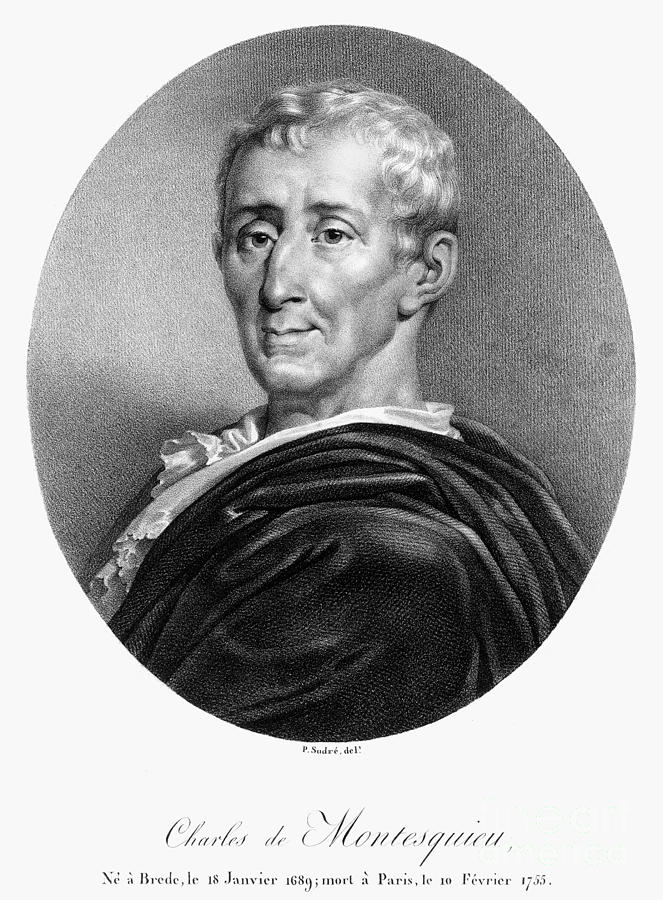
"Reason" in this context, means something akin to what we would call ideology or social theory. The delegates rarely justified their actions in terms of ideology or theory alone, but certainly "reason" lurked in the background, influencing their actions. The two main social philosophers who influenced the delegates were John Locke and the Baron de Montesquieu. Locke is reasonably known to most modern-day Americans. He popularized the social contract theory of government -- that government was formed when the people emerged from an anarchical "state of nature" and agreed to submit to a government to protect them. Unclear is how literally Locke mean it. Did he believe the people mutually agreeing on a government was an actual, historical occurrence, or was it simply a metaphor for saying that that the legitimacy of government depends on the people's consent? Whatever Locke's actual intention, the delegates intended to take him at his word and form an actual social contract.
| Montesquieu |
So the groundbreaking achievement of the U.S. Constitution was not in the separation of powers (as many textbooks seem to hint today), a concept that was already in existence. My next post will discuss what its real ground breaking achievements were.
_________________________________________________________
* Montesquieu saw liberty as compatible with hereditary monarchy, so long as the monarchy was governed by law, rather than arbitrary, and the separation of powers was maintained. Likewise, he believed that liberty could survive either a democratic or an aristocratic republic so long as the separation of powers was maintained, but that it would fail in a republic that did not maintain such separation.
Tuesday, January 1, 2013
Freedom: Quaker and Backcountry
While Puritan and Cavalier notions of liberty are quite foreign to us, Quaker and back country concepts are familiar. They live on today in the concepts of freedom espoused by the ACLU and the NRA, respectively.
Quakers
Quakers introduced a radical new idea to the concept of law and order –
that people need not all adhere to a common creed or fit into a common
hierarchy. Order simply meant people
refraining from intruding on each other’s peace. Quakers flogged and branded like anyone else
in the 17th Century, but they generally opposed capital punishment,
limiting it to cases of treason and murder.* Sheriffs were semi-elective -- a vote was held among multiple candidates, and the governor choose between the top two vote-getters. Quakers also had justices of the peace and peace keepers who arbitrated civil disputes. The Quaker approach
to law enforcement must have seemed dangerously permissive to their
contemporaries, yet crime rates remained relatively low (though not so low as
among the Puritans). The reason for
their low crime rates should be obvious.
They were Quakers (and Amish and Mennonites). A society of pacifists can control crime by
gentler means than other societies. Local government took place mostly at the county level, by elective
commissions and other officials. Elections were frequent, as often as five times a year, but less
demanding than a New England town meeting.
Perhaps as a result, voter turnout was usually lower than in Virginia,
but higher than in New England.
Fitting midway between their concept of local government and their
concept of liberty was the matter of how
politics were conducted. Quaker notions
of the conscience and the Inner Light meant a recognition of a right of
dissent. Long-standing differences of
opinion between large portions of the community regarded as normal, rather than
as a source of dangerous disruption.
Political parties began forming in Pennsylvania in the early 18th
Century, about the same time they began forming in England, and well before
they began to develop in any of the other colonies. While local government in New England
operated by consensus with strong pressure to conform, and in Virginia it was
little more than a spoils system, in Pennsylvania , the whole concept of
organized and civilized disagreement that makes democracy possible was being
born.
Quaker concepts of freedom were rooted in the Golden Rule – respect in
others the freedom you would have others respect in you. Quakers did not see freedom as a zero sum game. The saw it as the common right of all, and believed that the loss of freedom by one person(s) diminished the freedom of all. More remarkably, the Quakers lived up to this
ideal. Power corrupts, and Fischer
points out that all too often, people who are fierce in defense of their own
freedom when out of power have second thoughts about other people’s freedom
when in power. The Quakers in power extended to everyone else the same freedom they
claimed for themselves. Quakers were also the earliest opponents of slavery. If it was not their wish to be enslaved, then
it could not be right to enslave others.
Fischer believes that there was no material
reason slavery could not have flourished in the Delaware Valley; it was kept
out because of the strong commitment of the Quakers and Pietists to reject
it. Fischer calls this ideal reciprocal
liberty.
Reciprocal liberty had other implications as well. Limited government was part of reciprocal
liberty. Implicit in it, Fischer says,
was a clear distinction between the state and the larger society. Such a distinction would have been quite
foreign to the Puritans. Also implied
were that there were some things that were simply not government’s business
(another concept quite foreign to the Puritans). In particular, government had no business
legislating in matters of conscience.
But at the same time, the existence government was essential to reciprocal
liberty. Its role was to keep people
from infringing on each other.
Not all these ideas were unique to the Quakers. They were part of the stirring of the new ideology of classical liberalism that arose in the late 17th Century among the Whigs and their struggle to curb the power of
the king. William Penn, besides Quaker ideals of reciprocal liberty, endorsed the secular liberties of the Whigs. He guaranteed all colonists the secular rights to their lives, liberty and estate; representative government; and trial by jury. The right to trial by jury included the right to a speedy trial, to the same right of witness and counsel as the prosecution, and for the jury not to be punished for its verdict. No coincidentally, these are the same rights guaranteed in the Bill of Rights to the U.S. Constitution to this day.
Which leads to an important point.
The ideals that created the American Revolution were ones developed in
the late 17th Century by John Locke and other English Whigs. These ideas were not unique to the Quakers;
indeed, it was Jefferson, descendant of the Cavaliers who set them forth in the
Declaration of Independence and Madison, another such descendant, who enshrined
them in the Bill of Rights.
Back Country
Back Country ideals of liberty are also familiar to us. They can be found in any pronouncement by the
NRA or the gun lobby in general. The back country was settled by
people long excluded from political power, either in contemporary England, or
in the colonies in their early days. As
a result back countrymen came to look upon any formal government as something
hostile, alien, and inherently oppressive.
This went far beyond Quaker (or Cavalier) notions of limited government
to an ideal (at least in theory) of no formal government. Fischer calls this natural liberty, perhaps
because back countrymen so often seemed to aspire to an anarchical “state of
nature” that the other cultures dreaded.
Of course, the back country was never able to exclude formal government
altogether. But they generally sought to
limit its influence. Sheriffs, courts,
and other official means of keeping order coexisted with vigilante violence and
order maintained by private revenge.
Fischer cites the case of a judge who punished hog stealing with
hanging, and the rape of a five-year-old girl with a one shilling fine. What is does not add is that this did not
necessarily mean the judge took child rape lightly. He may just have wanted to allow the girl’s
family the satisfaction of inflicting the punishment themselves. "Order" in the back country meant retaliation in kind for any wrong done. And if formal government was regarded with deep distrust, they were not without leadership. Leaders were strong, charismatic individuals with a knack for getting things done, people like Andrew Jackson, who when a fire broke out in a stable, organized the townsmen to fight it, decked anyone who opposed him, and saved the town from burning down. And he did it through is own forceful personality, not any trappings of formal office. That was the sort of leader the backcountry respected.
Particularly strong in the back country concept of freedom was not only the ideal that all government was inherently dangerous to liberty, but that armed rebellion was the proper response the moment it stepped out of line. Fischer gives the example of Patrick Henry, a back countryman to the core. Patrick Henry was not just one of the most impassioned leaders of the American Revolution. Before any stirrings of rebellion began, as a lawyer he argued to a back country jury that the king, by disallowing some obscure act, had degenerated into a tyrant and forfeited all rights to their obedience. Cavalier gentlemen were shocked, but the back country jury responded favorably. He famously shocked low country gentlemen as well at the time of the Stamp Act, appearing to call for rebellion well before most people were even considering such a thing. At the same time, he did not hesitate to call anyone who opposed the Virginia Resolves and enemy of the colony. Natural liberty, Fischer comments, was not reciprocal. Respect for the rights of others was not a part of liberty in the back country.
I must confess to finding this the most puzzling part of "natural liberty," either as Fischer sets forth in his book, or in the NRA and gun lobby today. I can more or less understand that people who see freedom as a thing for every man to vindicate with his gun not being concerned with the rights of others. Presumably my neighbor has a gun of his own and is just as capable of vindicating his liberty as I am. This is the NRA view of freedom as an armed standoff, with no one daring to infringe on the rights of others for fear of armed retaliation. What I cannot understand is people who regard the proper response to the slightest provocation by the state as armed resistance simultaneously being willing to use the state to suppress people who disagree with them. This tendency has continued from Patrick Henry's calling opponents enemies of the colony to present day NRA calls to deport Piers Morgan for disagreeing with them over guns. Such an outlook, taken to its logical conclusion, would lead to endless civil war, as the "ins" use the power of the state to suppress the "outs" while the "outs" vindicate their rights with firearms.
In another work, Fischer comments that "Don't Tread on Me," with its emphasis on the first person singular, is very much a back country concept of freedom. Extending it a little further, the Puritan equivalent might be "Don't Treat on Us," the Quakers might say, "Don't Treat on Others," and the Cavaliers, "I Do the Treading."
Fischer proceeds to take his thesis too far, reducing almost everything that happens in US history to the interplay of the four cultures, which is certainly a great oversimplification. But it is a useful analysis nonetheless; one that I intend to make future use of.
_______________________________________________
*One thing I learned in law school was that today’s concept of first
degree and second degree murder was invented by the Quakers as a way of
reducing the number of executions.
Subscribe to:
Posts (Atom)